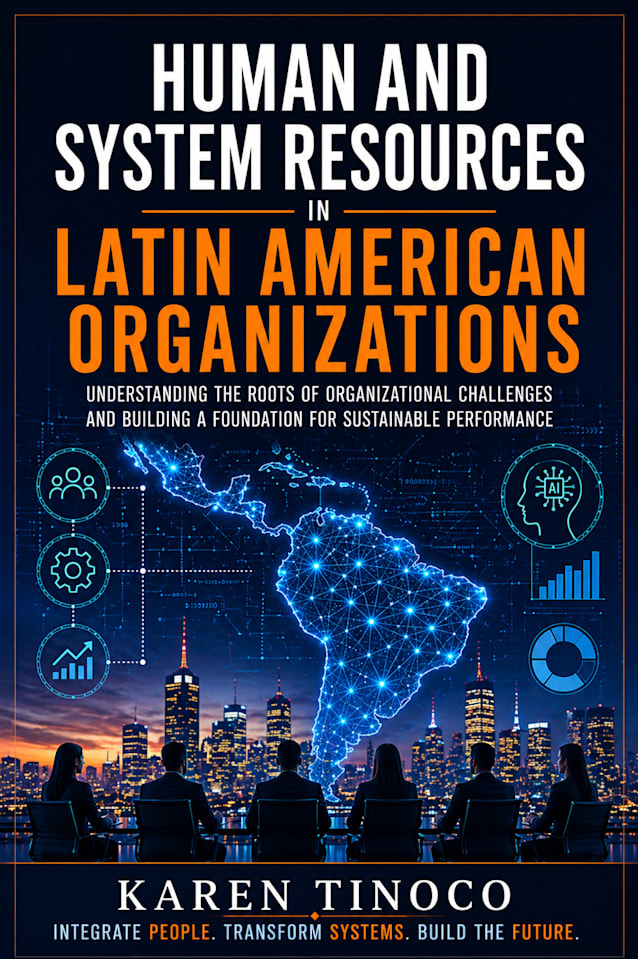
Human and Systems Resources in Latin American Organizations
About
The integration moment is here. Latin America is absorbing one of the most significant capital reallocations of the twenty-first century — while operating with structural conditions that no global management framework was built for. The next decade of regional enterprise will be defined by whether organizations can integrate their human capability with the artificial-intelligence and digital systems arriving at unprecedented speed, or whether the gap between people and platforms will continue to widen.
This research-grounded analysis offers Latin American executives, human-resources leaders, transformation officers, consultants, and scholars the framework they need to lead the integration agenda. Drawing on industrial and organizational psychology, strategic human-resources research, sociotechnical systems theory, and emerging-market strategy, the book introduces the Human–System Integration Maturity Model (HSIMM) — a five-domain, four-stage diagnostic framework calibrated to the institutional, cultural, and competitive realities of the region.
Across sixteen chapters and five parts, the book examines the historical and structural foundations Latin American organizations inherit; the cultural defaults that shape what works and what fails; the state of human capital, talent retention, and brain circulation in the mid-2020s; the digital, data, and artificial-intelligence maturity of the regional system; the eight misalignment patterns that consume regional enterprise value; and the Integrated Leadership Model — three foundations and six behaviors that produce integration capability under the cultural conditions the region actually carries.
Sixteen Framework Moments deliver proprietary diagnostic instruments organizations can apply directly: the Cultural Dimensions-to-Practice Crosswalk, the Human Capital Readiness Rubric, the Inclusion Diagnostic, the Retention Risk Map, the Digital Maturity Snapshot, the Data-to-Decision Capability Rubric, the AI Governance Checklist, the Misalignment Detector, the Psychological Safety Pulse, the Evidence-Based Human-Resources Decision Tree, the Human-Centered Design Micro-Process, the HSIMM Diagnostic, and more.
This is not a translation of imported frameworks. The book is built on the regional empirical work of ECLAC, the International Labour Organization, the Inter-American Development Bank, the GLOBE leadership research, Davila and Elvira, Castaño and colleagues, and the broader regional management research base — combined with more than fifteen years of operating leadership at Starbucks, Apple, and Amazon. Latin American organizations are positioned to claim a greenfield advantage by building the integrated architecture from the ground up — implementing once, correctly, while their mature-region peers spend the next decade unwinding accumulated integration debt.
Who this book is for: executives and senior leaders in São Paulo, Mexico City, Bogotá, Buenos Aires, Santiago, San José, and across the region; human-resources and transformation leaders in multinational and multilatina enterprises; consultants advising on integration, digital, and artificial-intelligence agendas; doctoral researchers in industrial-organizational psychology; and faculty teaching emerging-market strategy.
The integration moment is regional in expression and global in scope. The professionals who choose to operate at its center will determine whether the next generation of Latin American organizations is built well — or built fast and corrected later at substantial cost.